
Ingredients and know-how
How to Read a Corn Tortilla Label
Understand the serving size, get to know the ingredients, and make sense of the numbers and claims on your next package of tortillas.
A package of tortillas usually comes home with a meal in mind. Perhaps you are planning tacos with beans and roasted vegetables, or looking for something to fold around yesterday's chicken. You know the kind of dinner you want. The package can help you understand what you are bringing to it.
Start with a small detail from our own tortillas. The Nutrition Facts for Original lists a serving of two tortillas. For Street Taco, a serving is four. Both labels list 120 calories.
The explanation is in the weight: those two Original tortillas weigh 52 grams, while four smaller Street Taco tortillas weigh 55 grams. Looking at the count and weight together gives you a clearer picture of the food.
That is the pleasure of learning to read a label. A few details begin to connect, and the package becomes a useful guide to the tortilla inside.
Start with the serving
At the top of the Nutrition Facts panel, find the serving size and the number of servings per container. The first tells you the amount of food behind the figures below it. The second tells you how many of those servings are in the package.
For tortillas, the serving is described in pieces and grams. Both are useful. Pieces help you picture lunch; grams help you compare the amount of food in differently sized tortillas.
As the FDA explains serving size, it reflects an amount people typically consume. Your appetite and the meal you are making will determine your own portion.
Our ten-count Original pack contains five labeled servings. You might use two tortillas for one meal and four for another. Once you know how your portion relates to the serving, you can read the rest of the panel with that quantity in mind.
When comparing packages, check their serving weights before comparing the numbers. A smaller portion will naturally tell a different nutritional story.
Read the ingredients as a recipe
The ingredient list is another way into the food. Ingredients generally appear in descending order by weight, so the beginning of the list tells you what makes up the greatest share.
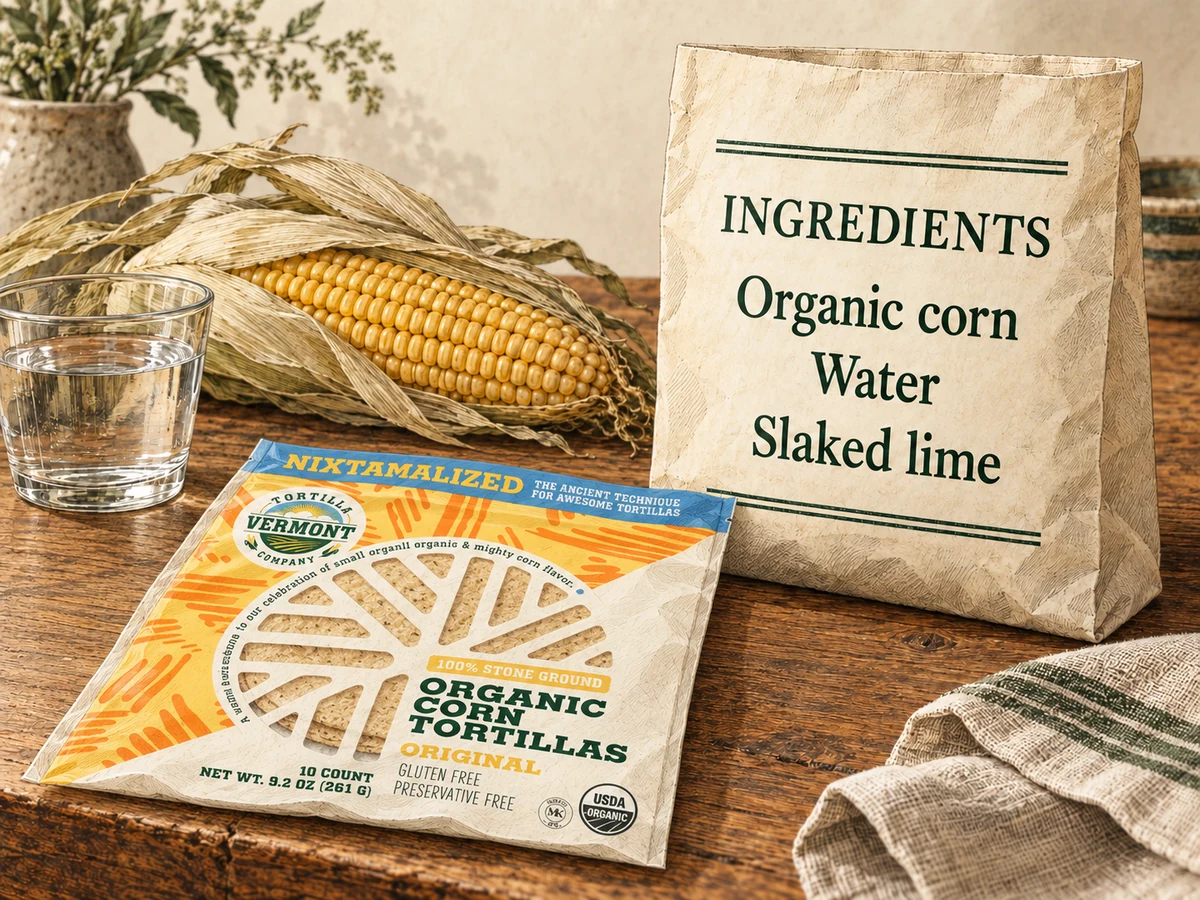
Our Original and Street Taco tortillas begin with three ingredients: organic corn, water, and slaked lime. Each has a job in preparing corn for a tortilla. Our Turmeric tortillas add turmeric, bringing an earthy flavor and golden color to the same basic preparation.
Reading this way helps you move from recognizing an ingredient's name to understanding its purpose. It also helps you identify the particular ingredients you want to include in your meals.
Some packages have longer lists. An ingredient may help retain moisture, adjust acidity, or preserve freshness. The FDA's guide to food ingredients explains these common roles. Calcium propionate, for example, is used as a preservative.
We make our tortillas without preservatives. Our choice keeps the recipe centered on the corn and the work of preparing it. The package's storage instructions explain how to care for the finished food at home.
What lime and masa tell you
Slaked lime may be the least familiar ingredient in that short list. Here, lime means food-grade calcium hydroxide, the alkaline ingredient used in nixtamalization.
At VTC, we cook and steep whole corn with lime and water, then wash it and stone-grind it into fresh masa. The treatment changes the grain so it can become the dough we shape into tortillas. You can follow the sequence in our tortilla-making process.
The preparation also affects the corn's nutritional qualities. CIMMYT's explanation of nixtamalization describes increased calcium content and greater availability of niacin, a form of vitamin B3. The calcium line on a particular tortilla's label tells you the amount in its serving.
You may also encounter masa harina, or corn masa flour. This is prepared flour made from nixtamalized corn. Water turns it into workable dough again. Masienda describes the connection in its guide to masa harina.
Fresh masa and masa harina share that earlier preparation of the grain. We choose to stone-grind fresh masa for our tortillas; recognizing the terms helps you understand the starting point another maker may use.
Put the nutrition numbers in context
Here are a few figures from our three tortilla labels. Each column shows the amount in that product's printed serving; notice the small difference in serving weight.
Swipe or scroll sideways to compare all three labels.
| Label information | Original, 6-inch | Street Taco, 4-inch | Turmeric, 6-inch |
|---|---|---|---|
| Serving size | 2 tortillas (52 g) | 4 tortillas (55 g) | 2 tortillas (52 g) |
| Calories | 120 | 120 | 120 |
| Dietary fiber | 3 g | 3 g | 3 g |
| Sodium | 5 mg | 5 mg | 5 mg |
| Added sugars | 0 g | 0 g | 0 g |
| Calcium | 90 mg | 100 mg | 90 mg |
You can read the complete Nutrition Facts for Original, Street Taco, and Turmeric.
Now imagine preparing four Original tortillas. That is two labeled servings. Multiplying the printed amounts gives 240 calories, 6 grams of fiber, and 10 milligrams of sodium for the tortillas. Four Street Taco tortillas are one serving, with the amounts shown in their column. The same number of tortillas can represent quite different portions.
The percentage column on the full label adds another reference point. Percent Daily Value, or %DV, describes how much a serving contributes to the daily reference amount for a nutrient. The FDA's general guide describes 5% DV or less as low and 20% DV or more as high for an individual nutrient.
Our Original label lists fiber at 11% DV and calcium at 6% DV. Sodium appears as 5 milligrams and 0% DV. That last example is a useful reminder to read the amount alongside the displayed percentage: the label still reports those 5 milligrams.
Choose the lines that help answer your question. You might want to compare fiber, check sodium, or see whether there are added sugars. Keeping the portion and units in view makes that comparison more useful.
What the organic claim means
The organic wording tells you about how ingredients were grown and the food was produced. At VTC, choosing organic corn is part of our attention to the ingredient at the center of our tortillas.
USDA's labeling categories give common package terms specific meanings. “100 percent organic” describes all-organic ingredients. “Organic” requires at least 95 percent organic ingredients, with rules for the remainder. “Made with organic…” requires at least 70 percent and cannot carry the USDA organic seal. These calculations exclude salt and water.
Organic production also prohibits genetic engineering. That connects the organic and non-GMO language you may see when learning about our corn.
The ingredient statement can help you identify which ingredients are organic. Together with the seal and certification information, it gives you a fuller understanding of that production choice. The Nutrition Facts panel supplies the separate information about the nutrients in your serving.
Finding the gluten-free information
Corn is naturally a gluten-free grain. On a package, a gluten-free claim applies to the finished food, including its ingredients and preparation.
The FDA's gluten-free definition includes ingredient requirements and a limit of less than 20 parts per million for unavoidable gluten. Our Original, Street Taco, and Turmeric tortillas are described as gluten-free in their product information.
If you are choosing food around an ingredient allergy, read the full ingredient information as well. A major allergen can be identified within the list or in a separate “Contains” statement. A “may contain” statement concerns possible cross-contact, such as contact through shared equipment, and is voluntary. The FDA explains these distinctions in its guide to reading labels for food allergies.
These statements answer different questions. Organic describes production choices; gluten-free addresses gluten in the finished product; the ingredient information helps you check for the particular foods you need to avoid. Reading them together gives each its useful place.
Bring the label into the kitchen
Before putting the package away, take a moment with its storage instructions. Our tortillas keep 21 days refrigerated or one year frozen. That gives you room to plan for dinner now and save some for another meal.
When you are ready to eat, warming helps prepare the tortillas for filling and folding. Our story about warming tortillas for a better fold follows that next step.
The meal will add its own ingredients. Beans, vegetables, cheese, sauces, and any cooking oil contribute alongside the tortillas. The label gives you the tortilla's part of the picture; what you prepare with it completes the plate.
That brings you back to the meal you had in mind when you picked up the package. You know the portion, recognize the ingredients, and understand a little more about how the corn was prepared. You can choose with that knowledge, warm the tortillas, and get on with making something you will enjoy.